Showing posts with label THE ENLIGHTENMENT - YUJI HOTTA. Show all posts

Sunday, April 10, 2011

Jean Jacques Rousseau and Frankenstein

Jean Jacques Rousseau’s philosophy influenced many things in the novel, “Frankenstein” by Mary Shelley. Rousseau was born in Geneva. In Frankenstein, Dr. Frankenstein was also born in Geneva. While Rousseau was learning about that the arts and sciences had improved or corrupted the morals of mankind, Dr. Frankenstein learned science and galvanism in his youthful days. These are new Enlightenment ideas. Both welcomed the new philosophy. In addition, Rousseau wrote his book about human right. He showed his idea; philosophy of right. Dr. Frankenstein made his creature, who wanted to have natural right as a creature like a lot of people did in this era. For instance, his monster cries and says, “Shall each man find a wife for his bosom, and each beast have his mate, and I be alone?” after Dr. Frankenstein denies to make new creature for him. His phrases sound like people’s words when people in this era couldn’t have any right. The monster’s passionate statement is likely to Rousseau’s statement. Both was influenced by the idea of the Enlightenment.

Jean Jacques Rousseau


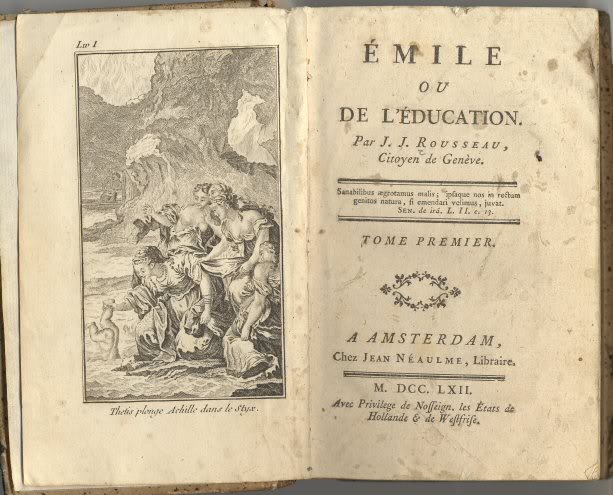
One of the most important philosophers in the Enlightenment era is Jean Jacques Rousseau. He was born at Geneva on June28th 1712. While he was learning music in his youthful days, he learned the idea that the arts and sciences had improved corrupted the morals of mankind. In 1754 he wrote the Discourse on the Origin and Foundations of Inequality, which emphasized about natural goodness of man and the corrupting influences of institutionalized life. In 1762, he saw The Social Contract which started the statement of "Man is born free; and everywhere he is in chains." At the time, he stated "Liberty, Equality, Fraternity," It became the slogan in French Revolution. His Philosophy of Right gave many successors new idea for the next era. Later, Rousseau’s great works effected Romanticism movement in Europe.


Thursday, April 7, 2011

The idea of the age of Enlightenment and Frankenstein


The Idea of the Age of Enlightenment and Frankenstein

From 17th to 18th century, the enlightenment era; the age of the enlightenment or the age of the reason was opened.  In this era, people found the new ideas; the discovery of the natural laws of the universe, determination of the natural right of mankind, and progress of knowledge, technical achievement and moral values. Most importantly, people in this era tried to find a reason for mankind existence without religious idea. Many scientists thought things more logically. For example, Isaac Newton found the gravity of the universe. Its idea leads to scientific and mathematical revolution.   
In the “Frankenstein” by Mary Shelley, Victor Frankenstein, main character, learned the enlightenment thinking. He is a student of the university. He tries to develop his idea that he makes a creature throughout the science. For instance, Victor says, “In rather philosophical and connected a strain, perhaps, I have given an account of the conclusions I had come to concerning them in my early years. As a child, I had not been content with the results promised by the modern professors of natural science. With a confusion of ideas only to be accounted for by my extreme youth, and my want of a guide on such matters, I had retrod the steps of the knowledge along the paths of time, and exchanged the discoveries of recent enquirers for the dreams of modern natural philosophy.” While Victor is growing up, he is learning many scientific ideas. He is thinking about discoveries for his dream. He has been increased his scientific knowledge like Isaac Newton did in the age of the Enlightenment.
In conclusion, he does success to make his creature, Frankenstein’s monster, in the story. His discovery to make the creature is definitely influenced by the idea of the Enlightenment.     

The resources
Isaac Newton Institute for Mathematical Science

Western New England College Essay by Professor Gerhard Rempel

Saturday, April 2, 2011

The Age of the Enlightenment

http://www.youtube.com/watch?v=4Vkx7hNXE3Y
The idea of the Enlightenment is the idea of the searching a reason, the idea of thinking about ourselves, the abuse of religious idea, and the challenge against authorities. Many Enlightenment thinkers spoke about their new ideas. As an example, the key Enlightenment thikers are Issac Newton, John Locke, Immanuel Kant, and Jean-Jacque Rousseau. Their ideas gives impact to people in the era. People followed these idea occured a lot of the big events in the world history; such as Imperialism, Industrial Revolution, the Declaration of the Independence, the Declaration of the Rights of Man and of the Citizen, and French Revolution.